


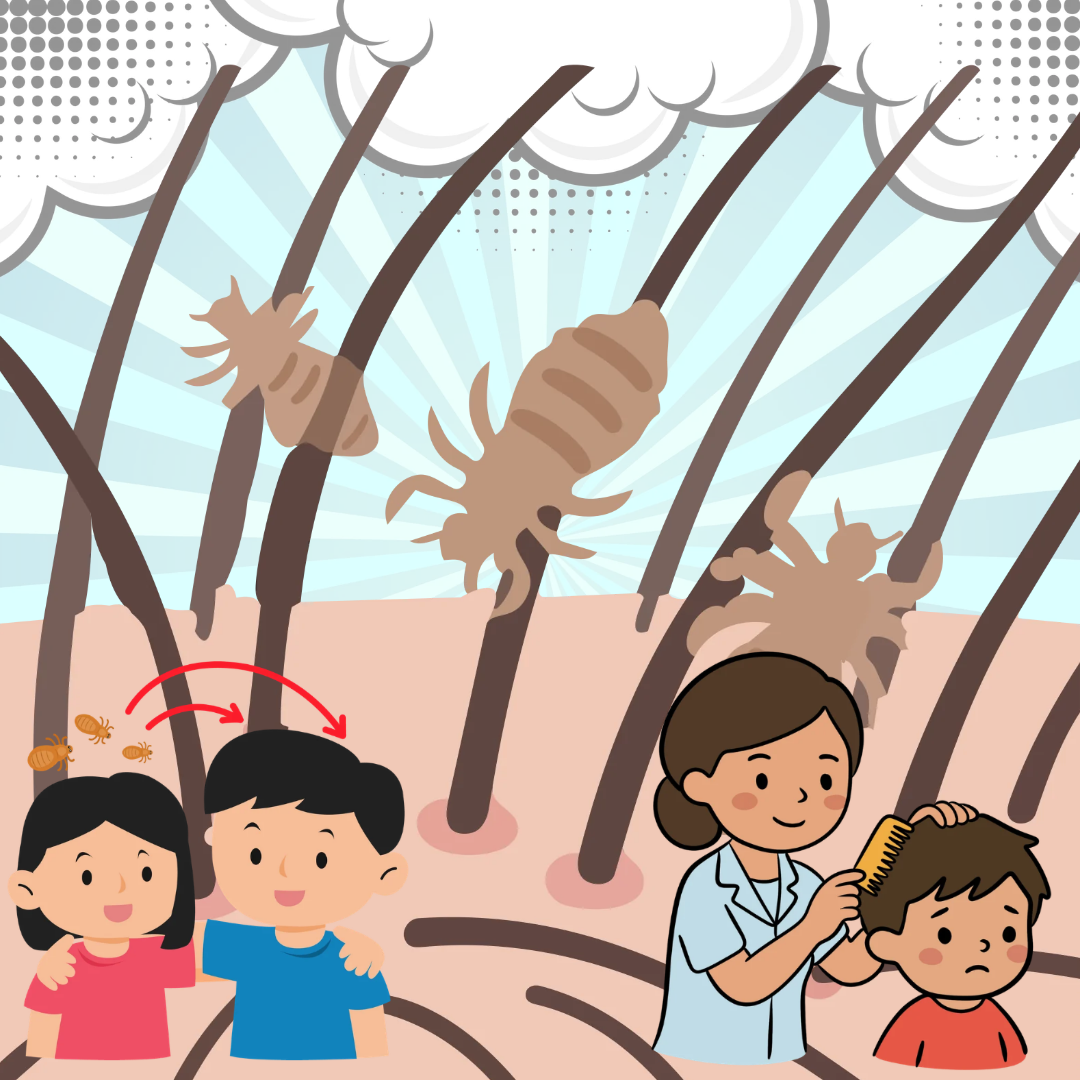
As colder weather brings winter coats, hats, and closer indoor contact among schoolchildren, Warm Springs Community Health professionals are reminding families how to identify, treat, and prevent the spread of head lice.
The guidance was featured on the recent episode of What the Health, the monthly Warm Springs Community Health podcast produced by KWSO, featuring community health physician Dr. Michaela Frey and Community Health office manager Leanne Smith.
While discovering head lice can be stressful for families, Frey noted that lice do not fly, jump, live on family pets, or transmit disease. Instead, they spread primarily through direct head-to-head contact. Because lice can be present for up to four weeks before itching begins, Frey explained that children with head lice do not need to be excluded from school—a shift from older policies.
“From a keeping kids in school perspective and only isolating people who really need it, this one has consistently been demonstrated to not impact people in such a way that the kids need to not be in school anymore,” Frey said. She added that separating coats, hats, and backpacks in classrooms, alongside early intervention, helps control the spread.
Rather than waiting for a child to start scratching, Smith—who spoke from her perspective as a parent and former teacher—recommended making daily hair checks a routine, focusing behind the ears and near the base of the scalp where hair is tied up.
To confirm an active infestation, parents should look for live adult lice or eggs, known as nits, located within a quarter-inch of the scalp. Frey noted that nits found farther down the hair shaft are unlikely to cause an active infestation.
When an infestation is found, families can treat it with over-the-counter or prescription medications, or through thorough wet-combing. Frey noted that at the Warm Springs clinic pharmacy, lice treatments—even those typically sold over the counter—require a provider visit and prescription under current policies.
Because store-bought treatments can be costly and certain medicated options are not safe for pregnant individuals or very young children, labor-intensive combing with a fine-toothed nit comb is an effective alternative. Smith recommended applying coconut oil to lubricate the hair and reduce discomfort while combing from the scalp to the ends. Frey advised repeating the combing process every couple of days and continuing for two weeks after live lice are no longer seen to account for the insect’s lifespan.
“I think that’s maybe the most helpful perspective to share is that there is light at the end of the tunnel, that it does eventually get better,” Frey said.
Alongside combing and treatment, household management helps prevent reinfestation. Frey recommended washing bedding, hats, coats, and plush toys in hot water and drying them on a hot cycle every two days during treatment. Items that cannot be washed or heated can be sealed in plastic bags for two weeks, and families should also remember to vacuum car seats and vehicle upholstery.
“I think that’s going to be the biggest thing of taking away and remembering that you get through it eventually,” Smith said. “Once you get it all done, if you can keep on top of it, it’s like that’s the biggest thing.”
Community members with questions about head lice treatments or home management can contact Warm Springs Community Health at the Health and Wellness Center. Additional educational resources are also available through the National Pediculosis Association at headlice.org.
